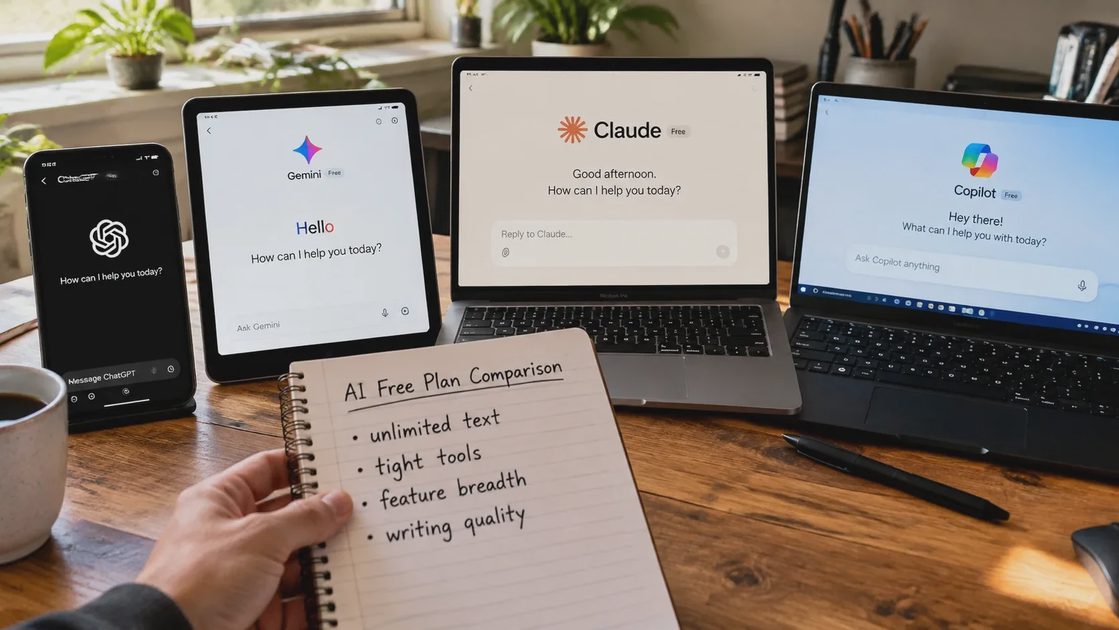
What changed in 2026
Two shifts reshaped the free AI landscape this year.
First, OpenAI removed text chat caps. In August 2026, ChatGPT Free moved from a rolling quota of 10 GPT-5.5 messages every five hours to unlimited text conversations on GPT-5.6 Luna. That is a structural change: for pure text back-and-forth, ChatGPT Free is now effectively unlimited, subject to abuse-prevention safeguards.
Second, Gemini became the most generous free tier for features. Google’s free plan now includes Gemini 3.6 Flash with Auto routing, Deep Research, Gemini Live voice, image generation, Canvas, and Gems—at no cost. No other major provider bundles that much into a free tier.
Claude did not follow. Anthropic kept its free plan tight, with rolling five-hour limits and access to a reduced model set. The gap between the most and least generous free tiers is now wider than it has ever been.
ChatGPT Free: unlimited text, tight tools

The model: GPT-5.6 Luna as the default, plus limited access to GPT-5-Thinking-mini.
What you get:
Unlimited text chats. No message cap on everyday conversation.
Web search with current information.
File and image uploads with separate usage limits.
Data analysis on uploaded files, limited.
Image generation, limited and slower than paid plans.
GPTs — you can use existing custom GPTs but cannot create your own.
Limited Deep Research, Codex, and ChatGPT Work access.
500MB storage in the Library.
What you do not get:
GPT-5.6 Sol reasoning, which is reserved for paid plans.
Creating custom GPTs.
Priority access during peak hours.
The catch: “Unlimited text” does not mean unlimited everything. The moment you upload a large file, generate an image, or ask a question that requires deeper reasoning, you hit separate caps. OpenAI does not publish exact numbers for these tool limits, which makes it hard to plan around them.
Best for: Everyday writing, brainstorming, quick research, and casual coding questions. If you mostly type and read, you may never need to pay.
Gemini Free: the most feature-rich free tier
The model: Gemini 3.6 Flash with Auto routing, plus limited access to Gemini 3.1 Pro.
What you get:
~30 prompts per day across general chat.
Deep Research — multi-source report generation at no cost.
Gemini Live voice conversations.
Image generation via Nano Banana Pro, roughly 20 images daily.
Veo 3.1 video generation access.
Canvas and Gems for structured work.
15GB Google cloud storage.
Google Workspace integration — Gmail, Docs, Sheets, Slides, Drive.
What you do not get:
Unlimited daily prompts. The ~30/day cap is real and resets daily.
Full Gemini 3.1 Pro access (limited to non-peak hours).
Gemini Spark personal agent and Deep Think, which are geographically limited.
The catch: Gemini’s free tier is the most feature-complete, but the daily prompt cap is the tightest among the three for sustained use. Thirty prompts sounds generous until you are deep in a research session and hit the wall at prompt 31. Google also changes these limits without announcement.
Best for: Research-heavy work, multimodal tasks (images, video, audio), and anyone embedded in Google Workspace. If you need Deep Research and do not want to pay, Gemini is the only free option.
Claude Free: best writing, tightest limits
The model: Claude Sonnet 4.6 or Haiku, depending on load and conversation length. Flagship models like Fable 5 and Opus 5.5 are not available on the free plan.
What you get:
~15–40 messages per rolling 5-hour window, depending on server load and message length. Community estimates put the practical daily range at 30–100 messages, dropping during peak hours.
200,000 token context window.
File uploads up to 20 files per chat, 500MB per file.
Web search access.
What you do not get:
Access to Claude’s best writing models (Fable 5.1, Opus 5.5).
Claude Code or Claude Cowork integration.
API access — the Claude API has no free tier beyond a small signup credit.
The catch: Claude’s free plan is the most restrictive of the three. If you write long documents or have extended back-and-forth sessions, you will exhaust your allowance faster than you expect. Anthropic does not publish exact limits, so you cannot predict when you will hit the wall.
Best for: Short, high-quality writing tasks where tone matters more than volume. If you need to draft a client email and want it to sound human, Claude Free is worth the tight limit. If you need to write 20 emails, use ChatGPT.
Copilot Free: the quiet middle option
The model: Microsoft’s latest models at non-peak hours, with 15 image boosts per day.
What you get:
Chat and web search, subject to capacity and limits.
Image generation, roughly 15 images at normal speed.
Microsoft 365 integration is not available on the free plan.
What you do not get:
Published usage limits. Microsoft does not disclose token quotas or fixed message caps for Copilot Free.
Word, Excel, and PowerPoint integration, which requires a Microsoft 365 subscription.
The catch: Microsoft’s opacity is the problem. You cannot plan around limits you cannot see. The free tier works, but when you hit the capacity ceiling, the only options are to wait or upgrade.
Best for: Windows users who want a built-in AI assistant and do not need Microsoft 365 app integration.
Free plans compared
ChatGPT Free | Gemini Free | Claude Free | Copilot Free | |
|---|---|---|---|---|
Default model | GPT-5.6 Luna | Gemini 3.6 Flash | Sonnet 4.6 / Haiku | Unspecified |
Text chat limit | Unlimited | ~30 prompts/day | ~15–40 msgs/5hr | Undisclosed |
File uploads | Limited | ✔ | 20 files, 500MB each | Limited |
Image generation | Limited, slow | ~20 images/day | ✖ | ~15/day |
Deep Research | Limited | Yes, free | ✖ | ✖ |
Voice mode | Limited | Yes | ✖ | ✖ |
Context window | ~27K (GPT Instant) | 32K | 200K | Undisclosed |
Best free strength | Volume text work | Feature breadth | Writing quality | Windows integration |
Biggest free weakness | Tool limits are opaque | Tight daily prompt cap | Very low message cap | No published limits |
When you actually need to pay
The free tier is enough if you:
Type questions and read answers.
Write short emails, summaries, or social posts.
Do occasional image generation.
Use one tool for a few hours a day, not all day.
You need a paid plan if you:
Upload large files or do data analysis regularly.
Need GPT-6 Sol reasoning, Claude Opus 5.5, or Fable 5 writing quality.
Run Deep Research or multi-source synthesis at volume.
Use AI as a core part of your job, not a supplement.
The cheapest paid step is Gemini AI Plus at $4.99/month, followed by ChatGPT Go at $8/month. Claude Pro and ChatGPT Plus both sit at $20/month. If you only need one upgrade, start with the free tier that matches your primary task and pay for the one that removes your specific bottleneck.
FAQ
Is ChatGPT really unlimited for free now?
For text conversations, yes. OpenAI removed the rolling message cap in August 2026. But file uploads, image generation, voice, Deep Research, and Codex all have separate limits that OpenAI does not publish.
Which free AI plan is the most generous?
Gemini. It bundles Deep Research, image generation, voice mode, and 15GB storage into the free tier—features that ChatGPT and Claude charge for or omit entirely.
Can I use Claude for free without hitting limits quickly?
No. Claude Free has the tightest message limits of the major assistants, estimated at 15–40 messages per five-hour window. If you need sustained use, Claude is the wrong free tier.
Do free AI plans train on my data?
It depends on the provider. ChatGPT Free may use your conversations for training by default in some regions. Claude allows you to turn off model training. Gemini’s data policies vary by Google account settings. Check each provider’s privacy settings before uploading sensitive material.
Which free plan is best for students?
Gemini, if you use Google Workspace. Gemini Free integrates with Docs, Sheets, and Drive, and includes Deep Research for paper sourcing. ChatGPT Free is better for writing help and brainstorming. Claude Free is best for polishing prose, but the limits are too tight for regular academic use.
What about free API access?
OpenAI’s API has no meaningful free tier—new accounts get a small one-time credit. Google AI Studio offers free API access with daily limits (20–1,500 requests/day depending on the model). OpenRouter provides 50 free requests per day until you spend $10, after which the daily limit rises to 1,000.
Will free plans get better or worse in 2027?
The trend in 2026 was toward more generous text chat and tighter tool limits. Free plans are becoming good enough for casual users while paid plans capture the professional and power-user segments. Expect that split to continue.


Letters
No letters yet — be the first to write.